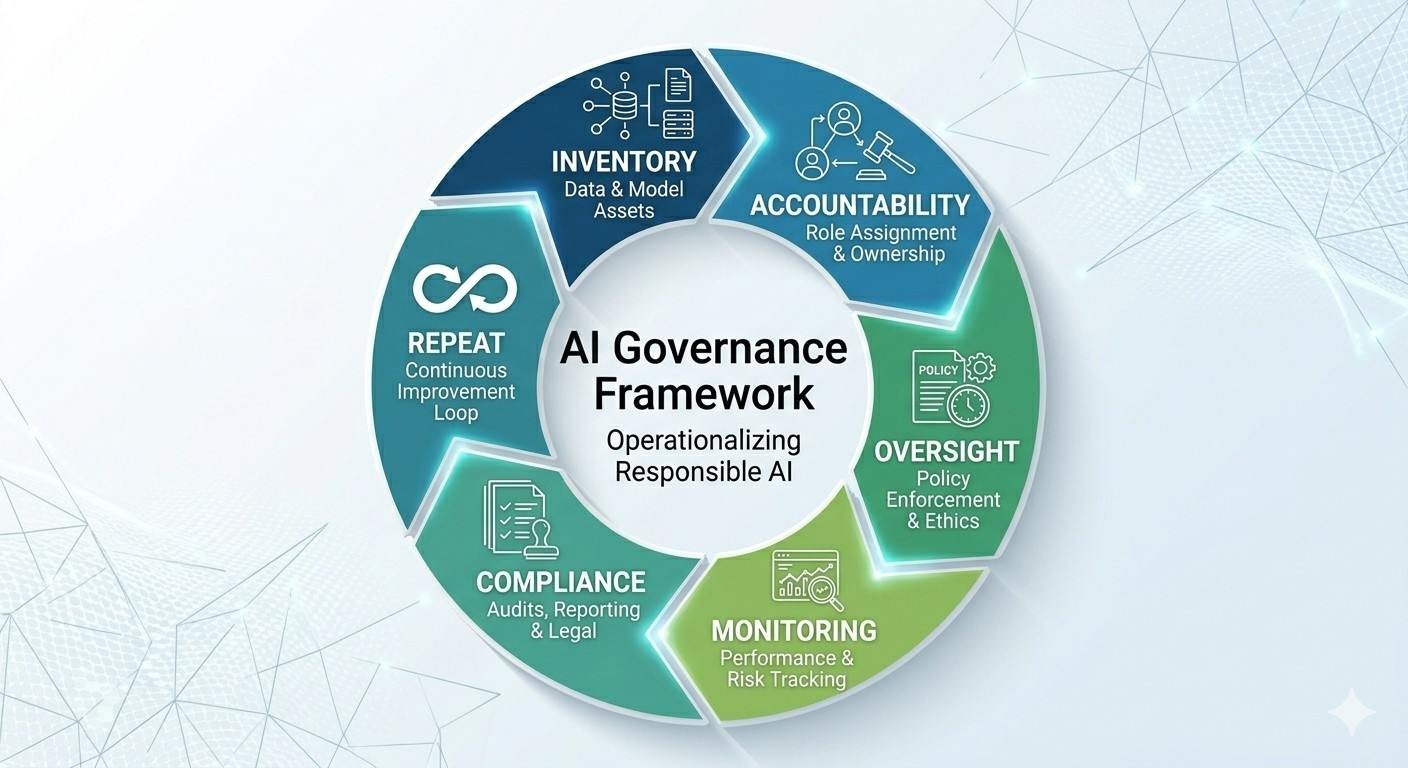
AI Transformation Is a Problem of Governance
Billions of dollars are being invested in artificial intelligence every year. Enterprise AI spending is projected to hit $665 billion in 2026. And yet, most organizations are not seeing the returns they expected. The reason is not the technology — it is governance.
The tools are powerful. The models are capable. The infrastructure is ready. But according to McKinsey, Deloitte, Gartner, and dozens of independent research firms, the real bottleneck is something far less glamorous: governance.
AI transformation is a problem of governance — and until organizations truly accept that, the same expensive cycle of pilots, stalls, and abandoned projects will keep repeating.
What Does “AI Governance” Actually Mean?
Many organizations confuse governance with compliance. AI governance is not a PDF sitting in a compliance folder. It is not a legal checkbox. It is operational infrastructure that covers the full AI lifecycle.
A mature AI governance framework includes:
- AI inventories — a full register of every model, tool, and agent running in production
- Lifecycle controls — clear approval gates for development, testing, and deployment
- Accountability structures — defined ownership at every stage of an AI system’s life
- Runtime monitoring — behavior tracking in production, not just in development
- Ethical guidelines — policies that govern how AI decisions affect people
- Regulatory compliance — alignment with the EU AI Act, CMMC 2.0, and ISO 42001
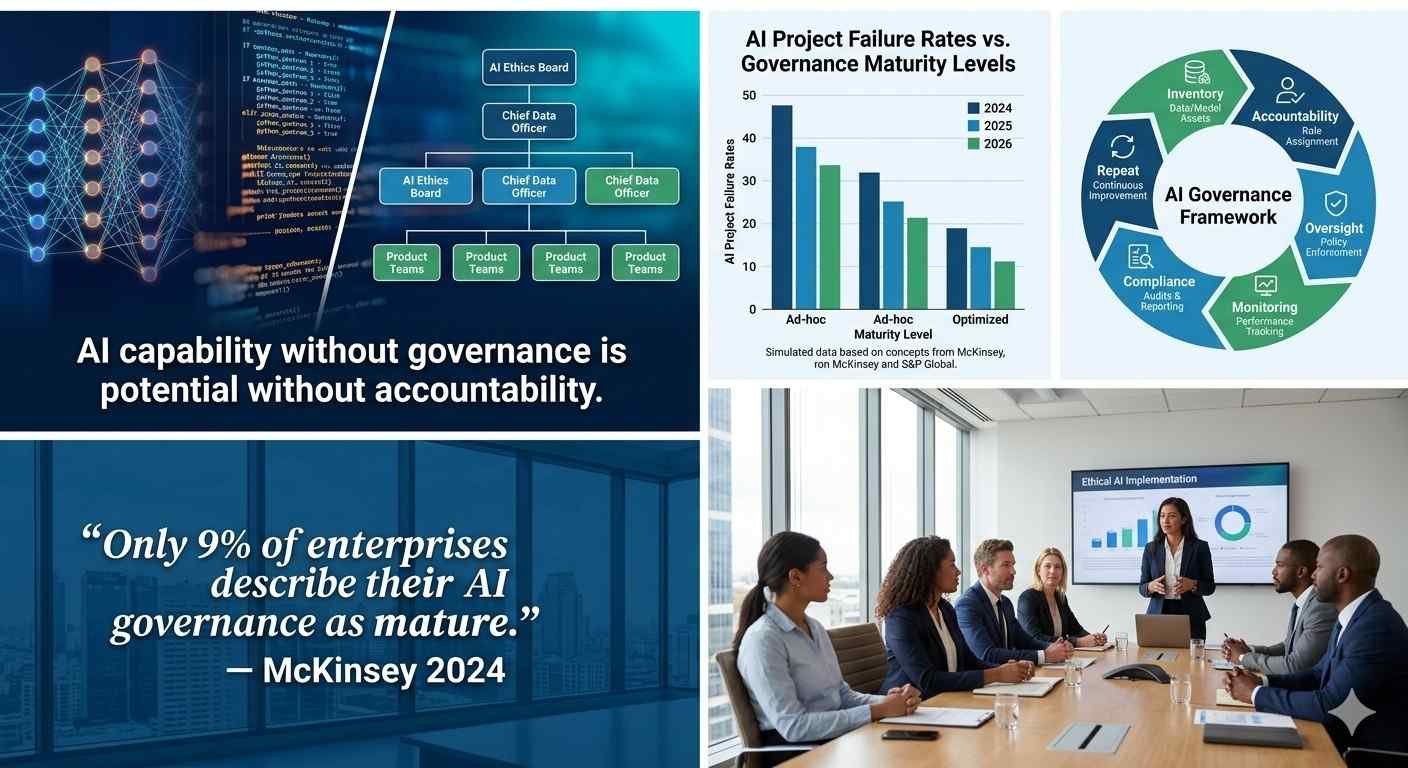
Figure 1: AI governance covers the full lifecycle — from inventory and accountability to monitoring and regulatory compliance.
Why Technology Is Not the Real Barrier
It is tempting to blame AI failures on technical limitations — model hallucinations, data quality issues, integration complexity. These are real challenges. But they are solvable engineering problems. Governance failures are organizational and structural — and far harder to fix.
1. No Clear Ownership of Risk
When an AI-powered underwriting model denies a loan, or a hiring algorithm filters out qualified candidates, the failure is almost never in the math. It is that no one defined who owns the risk when the system goes wrong.
According to McKinsey, just 28% of CEOs take direct responsibility for AI governance, and only 17% of boards formally own it. AI systems shaping pricing, credit, and recruitment are running without a clear chain of accountability in roughly four out of five enterprises.
2. Shadow AI Is Growing Uncontrolled
Gartner has identified shadow AI as one of the most critical emerging enterprise risks. By 2030, Gartner predicts more than 40% of enterprises will experience security or compliance incidents linked to unauthorized shadow AI. Additionally, 69% of surveyed organizations suspected employees were actively using prohibited public generative AI tools.
Key insight: Shadow AI is rarely just an employee discipline issue. It is almost always a symptom of weak governance design. When policy only says “no,” employees find workarounds — and the organization loses visibility over what AI is actually doing inside its walls.
3. The Scaling Ceiling
Deloitte’s 2026 research found that only 25% of enterprises had moved 40% or more of their AI experiments into production. Giving employees access to AI tools is not the same as transforming a business with AI.
McKinsey found that companies capturing real value from AI are not just adopting more tools — they are redesigning workflows, operating models, data foundations, and governance practices around the technology. CEO oversight of AI governance was among the factors most strongly correlated with measurable bottom-line impact.
The hype phase is officially over. We are now in the accountability phase. The organizations winning in 2026 are not those with the best algorithms — they are those with the best governance.
— Synvestable Enterprise AI Research, 2026What a Governance-First Architecture Looks Like
The organizations winning with AI in 2026 are those who built governance infrastructure before scaling deployment. Here is what that looks like in practice:
-
1Build a Complete AI Inventory
Map every AI tool, model, and agent in use across the organization. Capture the business function, data access, owner, and applicable regulations. Most enterprises discover dozens of tools they did not officially sanction.
-
2Define Accountability Structures
Every AI system needs a named owner responsible for monitoring behavior, responding to incidents, and ensuring compliance. At the board level, AI governance must be formally incorporated into committee charters — not just discussed informally.
-
3Embed Human Oversight Into Consequential Workflows
Not every AI decision needs human review — but those affecting credit, employment, healthcare, or legal rights need Human-in-the-Loop (HITL) protocols built in before deployment, not after the first incident. The EU AI Act makes this mandatory for high-risk AI systems.
-
4Establish Continuous Production Monitoring
AI systems drift. Data distributions change. Runtime monitoring must track model behavior in production — drift from expected outputs, bias indicators, and anomalies suggesting misuse. Monitoring must begin before the first incident, not in response to one.
-
5Map Every System to Compliance Frameworks First
For organizations in regulated industries or jurisdictions: the EU AI Act is now fully enforced with penalties up to €35 million or 7% of global annual turnover. For US government contractors, CMMC 2.0 enforcement began in 2025. Compliance mapping is a day-one requirement, not a post-deployment task.
Governed vs. Ungoverned AI: A Side-by-Side View
| Dimension | Without Governance | With Governance-First |
|---|---|---|
| AI Project Outcome | 73% fail to meet ROI | Sustainable scale achieved |
| Risk Ownership | Unclear / fragmented | Named owner per system |
| Regulatory Exposure | High — retroactive fixes | Low — mapped at design stage |
| Shadow AI Risk | Undetected, growing | Controlled via approved channels |
| Board Visibility | Limited or absent | Formal charter responsibility |
| Pilot → Production Rate | <25% reach production | Governed path enables scaling |
| Incident Response | Reactive, after damage | Proactive monitoring & alerts |
The Cultural Dimension: Building an AI-Ethical Organization
Governance frameworks are only as effective as the culture that surrounds them. Leaders who are succeeding with AI are not just building policies — they are fostering a culture of AI ethics and accountability throughout their organizations.
- Training employees at every level on AI risks, not just AI capabilities
- Creating safe channels for reporting concerns about AI system behavior
- Rewarding teams that surface governance problems early rather than penalizing them
- Making ethical AI use a performance metric, not just a compliance footnote
This cultural shift is especially critical as agentic AI — systems capable of reasoning, planning, and executing tasks independently — becomes more prevalent. The stakes of governance failures rise dramatically when AI can take real-world actions autonomously.
Practical Tips for Leaders Starting Their Governance Journey
- Start with a governance audit. Map every AI tool in use across the organization. You will likely be surprised.
- Appoint a Chief AI Officer or AI Governance Lead with real authority and resources.
- Adopt a recognized framework — ISO 42001, the NIST AI Risk Management Framework, or the EU AI Act structure.
- Create a cross-functional AI governance committee including legal, compliance, IT, HR, and business unit leaders.
- Set measurable governance KPIs — percentage of AI projects reaching production, audit completion rates, incident response times.
For more resources to support your AI strategy, explore YonoPress’s curated AI tools directory, which covers the platforms enterprise teams are using to build responsibly. The YonoPress resources hub also offers guides on governance frameworks and compliance checklists. For a complete overview of the YonoPress platform itself, see what YonoPress is and how it works.
Real-World Example: The Difference Governance Makes
Consider two enterprises of similar size, both investing in AI-powered customer service automation in 2024.
Enterprise A built fast. They deployed a large language model for customer interactions within three months, with minimal oversight. Within six months, the system produced inconsistent responses and shared incorrect pricing information. A regulatory inquiry followed. The project was paused for eight months while governance was retrofitted. Total cost: far higher than the original build.
Enterprise B took four months to deploy a similar system — but spent the first month mapping accountability, defining escalation protocols, establishing monitoring dashboards, and completing a compliance review. The system launched with oversight built in. Issues were caught early. The system ran for 18 months without a significant incident and was subsequently expanded to three additional business units.
The difference was not technology. It was governance. Enterprise B did not move slower — they moved smarter. They invested one month in governance upfront and saved eight months of remediation.
For a deeper look at how AI tools are being evaluated and selected by enterprise teams, see the YonoPress reviews section, or read the community’s perspective on the complete guide to YonoPress and how YonoPress.com serves content teams.
Frequently Asked Questions
AI technology is increasingly capable and accessible. The barriers to successful AI transformation are organizational — unclear ownership of AI risk, absence of oversight protocols, lack of compliance infrastructure, and cultural resistance to accountability. Research from McKinsey, Deloitte, and Gartner consistently shows that governance gaps, not technical limitations, are the primary cause of enterprise AI failures.
AI governance is the set of policies, processes, accountability structures, and monitoring systems that control how AI is developed, deployed, and used within an organization. Without governance, AI systems can produce harmful outputs, create compliance liabilities, and fail to deliver business value. In 2026, it is also a regulatory requirement under the EU AI Act.
Shadow AI refers to unauthorized use of AI tools within an organization — typically because approved alternatives are too restrictive or unavailable. Gartner predicts that by 2030, more than 40% of enterprises will experience security or compliance incidents linked to shadow AI. Strong governance addresses this by creating accessible, approved AI channels and making governance practical rather than purely prohibitive.
Start with a complete AI inventory, assign clear ownership for each system, embed human oversight into high-stakes workflows, establish continuous production monitoring, and map every system to applicable compliance frameworks before handling regulated data. Leadership commitment at CEO and board level is essential.
The most significant are the EU AI Act (fully enforced, with penalties up to €35 million or 7% of global turnover), CMMC 2.0 for US government contractors (enforcement began 2025), and ISO 42001. Sector-specific regulations in financial services, healthcare, and employment increasingly govern AI use in consequential decisions.
Governance Is Not a Constraint — It Is the Competitive Advantage
The hype phase of enterprise AI is over. 2026 is the accountability phase.
Organizations that continue treating governance as an afterthought will keep funding expensive cycles of pilots that never scale. The statistics are unambiguous: AI transformation is a problem of governance, and governance is the solution.
The good news is that governance is entirely within organizational control. Unlike model capability, it does not require the most advanced tools. It requires the right structures, the right accountability, and the right culture.
The enterprises generating consistent, auditable, durable returns from AI are not those who moved fastest. They are those who built governance infrastructure that turns model capability into organizational accountability — and built it before deployment, not in the aftermath of failure.
For leaders evaluating AI strategy in 2026: the question is no longer whether to govern AI. The question is how quickly governance can be made operational. Explore YonoPress SEO tools and the YonoPress blog for more expert guidance on AI and digital strategy.